


Page 8 - Demo
P. 8
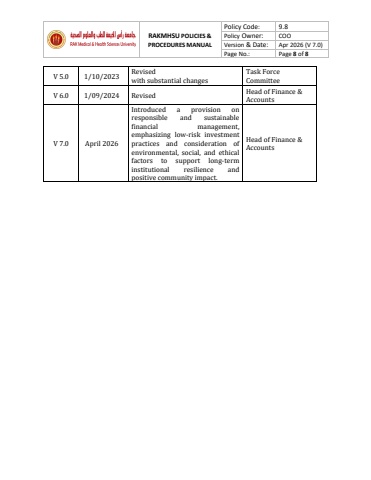
RAKMHSUPOLICIES&PROCEDURESMANUALPolicy Code:9.8PolicyOwner:COOVersion& Date:Apr 2026(V 7.0)Page No.:Page 2of 8Budget Insufficiency Risk involves the risk of running short of budget due to declining revenues related to a potential drop in student enrollment/ decreasing demand on certain programs or due to uncontrolled increases in expenditures or financial losses during the normal course of business activities which might be caused by uncontrollable circumstances such as fire, theft, claims by third parties for damages or losses, which will ultimately affect the University%u2019s ability to meet its obligations.Compliance Risk: This is the risk of not conforming to financial rules, regulations, standards,and laws. This mainly includes the risk of not complying with VAT regulations, general pension, social security regulations, and financial reporting standards.Financial Risk Evaluation and Mitigation MethodologyCredit RiskFinancial assets, which potentially subject the University to the concentration of credit risk, consist of the current bank accounts and deposits/ saving accounts. The University mitigates its credit risk concerning bank deposits throughout:%u2022Dealing with high-credit quality financial institutions and conducting continuous reviewsof the financial institution%u2019s credibility, considering the trade-off between the benefits obtained from dealing with certain financial institutionsand the creditrisk involved.%u2022Extra available funds are invested in short-term fixed deposits that do not exceed 1-year maturities and over several maturity dates, carefully distributed throughout the year to ensure satisfying any urgent needs for cash to meet operational requirements while avoiding the liquidation of such deposits before the maturity date and thus losing the expected returns.%u2022RAKMHSU seeks to manage and invest its financial resources in a responsible and sustainable manner that supports the University%u2019s educational, healthcare, and societal mission. In line with financial risk management, the University prioritises low-risk investments and gives due consideration to environmental, social, and ethical factors where feasible. This includes avoiding high-risk or unethical financial practices and, where appropriate, supporting investments that contribute to longterm institutional resilience, social well-being, and positive health and community outcomes.%u2022The University%u2019s management continuously evaluates its investment credit risk to ensure that the credit risk related to bank accounts lies within an acceptable range.


